

Menopause Hormone Therapy (MHT/HRT) – Part 1

Revisiting the Women’s Health Initiative (WHI): How Two Decades of Evidence Have Reshaped Menopausal Hormone Therapy
Menopause is a natural yet transformative phase in a woman’s life. Beyond marking the end of menstruation, it triggers a cascade of hormonal shifts that influence systemic wellness, bone health, cardiovascular function, genitourinary integrity, sleep, mood, and long-term brain health. For decades, menopause hormone therapy (MHT)—long known as hormone replacement therapy (HRT)—has been the most effective pharmacologic option for relieving bothersome menopausal symptoms, particularly moderate-to-severe vasomotor symptoms (hot flashes and night sweats) and genitourinary syndrome of menopause.
As part of the ongoing Rutgers Women’s Brain Health Initiative series—following our foundational exploration of perimenopause—this two-part article examines how recent clinical updates and scientific milestones are reshaping the conversation around MHT. Part 1 introduces MHT, recounts its complex history, explains the landmark Women’s Health Initiative (WHI) findings and their consequences, and describes the evidence-driven course correction that led to the 2025–2026 FDA labeling updates. Part 2 will build on this foundation by exploring the “window of opportunity,” emerging population-scale evidence, nuanced risk profiles, access challenges, nonhormonal alternatives, and practical clinical guidance.
Early History and Rising Use
Estrogen preparations for menopausal symptoms date to the early 20th century. Injectable estrogens appeared in the 1920s–1930s; the first oral conjugated equine estrogens (Premarin) received FDA approval in 1942. Use grew substantially through the mid-20th century for treatment of vasomotor symptoms (e.g., hot flashes and night sweats), genitourinary symptoms, and later for perceived benefits on bone density and cardiovascular health, supported largely by observational data.
However, the medical community learned a critical lesson in the 1970s when unopposed estrogen therapy was linked to an increased risk of endometrial cancer. This discovery led to the standard clinical practice of routinely adding progestogen for women with an intact uterus to protect the uterine lining. By the late 1990s and early 2000s, MHT use had become widespread, with many clinicians and women viewing it as broadly protective against chronic diseases.
The Women’s Health Initiative Trials: Design and Initial Findings
The WHI hormone trials, launched in 1991 by the National Institutes of Health, were large, randomized, placebo-controlled studies designed primarily to test whether MHT could prevent coronary heart disease (CHD) and other chronic diseases in postmenopausal women. They enrolled more than 27,000 women aged 50–79 years (mean age ~ 63) across two parallel arms:
- Estrogen plus progestin (conjugated equine estrogens [CEE] 0.625 mg plus medroxyprogesterone acetate [MPA] 2.5 mg daily) in women with an intact uterus (n ~ 16,608).
- Estrogen alone (CEE 0.625 mg) in women with prior hysterectomy (n ~10,739).
The trials used oral formulations common at the time. The estrogen plus progestin trial arm was stopped early in 2002 (mean follow-up roughly 5.2 years) because overall health risks exceeded benefits. Key findings included increased risks of CHD, stroke, pulmonary embolism, and invasive breast cancer, alongside reduced risks of fractures and colorectal cancer. The estrogen-alone trial arm was also later stopped, primarily due to increased stroke risk.
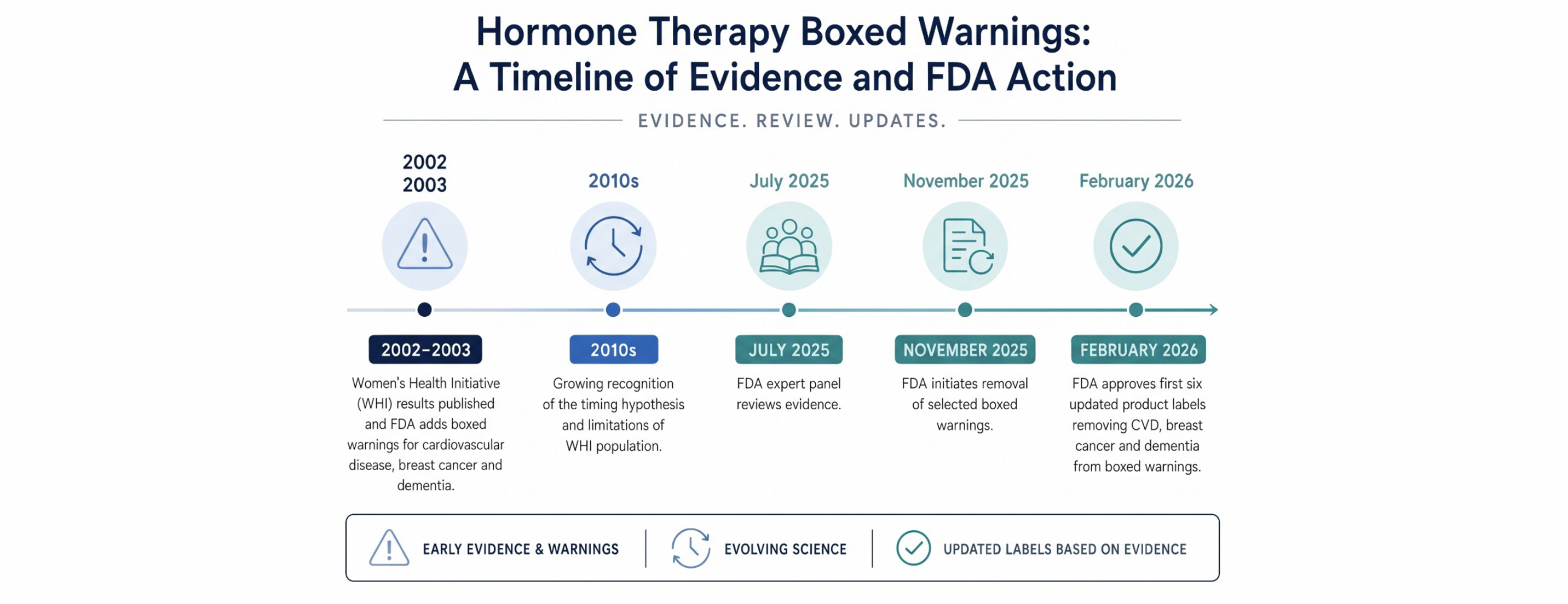
The 2002 JAMA publication describing the WHI hormone trial results and accompanying media coverage produced widespread alarm. Prescriptions plummeted overnight, and menopause education in medical training contracted sharply. Regulatory bodies around the world (including FDA) instituted class-wide boxed (“black-box”) warnings on all estrogen-containing products, citing risks of cardiovascular disease, breast cancer, and probable dementia. These warnings were applied broadly (including to low-dose vaginal estrogen) and emphasized using “lowest effective dose for the shortest duration”.

New Analysis Reveals Limitations and Flawed Extrapolation
Subsequent scrutiny revealed important limitations of the WHI hormone trials that contributed to over-generalization:
- Age and Timing Discrepancies: The average participant in the WHI trials was approximately 63 years old and more than a decade past the onset of menopause, whereas most women seeking symptom relief initiate therapy much closer to the menopausal transition.
- Formulation Narrowness: The WHI trials evaluated oral conjugated equine estrogens (CEE), either alone or combined with medroxyprogesterone acetate (MPA). Their findings should not automatically be generalized to lower-dose or transdermal estradiol regimens or to other progestogens; direct comparative outcome evidence remains limited.
- Low Absolute Risks in Younger Cohorts: Absolute risks for younger women were low. Subsequent age- and time-since-menopause stratified analyses demonstrated more favorable or neutral cardiovascular and mortality profiles when therapy was initiated before age 60 or within 10 years of menopause onset.
- Divergent Estrogen-Alone Patterns: In women with prior hysterectomy, randomized WHI follow-up analyses identified different breast cancer patterns with CEE alone than with CEE plus MPA. Those results should not be generalized to every estrogen product.
Subsequent analyses reinforced the importance of absolute risk, age at initiation, time since menopause, and specific regimen. The WHI trials identified genuine risks, but broad extrapolation of findings from the studied oral regimens to all patients and formulations contributed to lasting confusion about treatment for menopausal symptoms.
Reanalysis, New Evidence, and the 2025–2026 Course Correction
Over the past two decades, rigorous reanalysis of WHI trials data, extended long-term follow-ups, observational studies, and newer clinical trials have reshaped the medical consensus. Notably, a 2025 secondary analysis of WHI data focusing specifically on women with moderate-to-severe vasomotor symptoms found that both CEE alone and CEE combined with MPA effectively relieved symptoms in women aged 50 to 59 without significantly increasing atherosclerotic cardiovascular disease risk; risks began rising primarily in women aged 70 and older.
A 2026 observational analysis using data from the Study of Women’s Health Across the Nation (SWAN) reported an approximately 22% lower rate of cardiovascular events associated with MHT initiation among midlife women experiencing vasomotor symptoms. Associations varied across racial and ethnic subgroups. Residual confounding and selection effects remain possible, so these findings do not establish cardiovascular protection or justify prescribing MHT to prevent cardiovascular disease.
A pivotal turning point occurred when the FDA convened an expert panel on July 17, 2025—which included prominent leaders such as Dr. Roberta Brinton—to thoroughly review contemporary evidence regarding benefits, risks, formulations, routes of administration, dosing, and timing. Panelists underscored the clinical inaccuracy of class labeling (particularly for low-dose vaginal estrogen), the distinct safety profile of local therapy for genitourinary syndrome of menopause, the differences between estrogen-alone and combined regimens, and the necessity of shared decision-making.
Regulatory Milestones: The 2025–2026 FDA Labeling Updates
Public interpretation of the original WHI findings often did not adequately distinguish the study population and tested oral formulations from younger symptomatic patients and other MHT regimens. Subsequent evidence prompted renewed evaluation of how treatment risks are presented in regulatory labeling.
Following an FDA expert panel convened in July 2025 to examine the available evidence, HHS and the FDA announced plans in November 2025 to revise hormone therapy boxed warnings. The regulatory process addressed how cardiovascular disease, breast cancer, and probable dementia risks were communicated while preserving clinically relevant safety information.
On February 12, 2026, the FDA approved updated labeling for an initial set of six products spanning systemic combination, estrogen-alone, progestogen-alone, and topical vaginal therapies, supporting systemic use for moderate-to-severe vasomotor symptoms in women younger than 60 or within 10 years of menopause onset.
Importantly, removing risk statements from a boxed warning does not mean those risks have disappeared. Relevant risks remain described elsewhere in systemic product labeling. The revisions are intended to support more accurate, individualized discussions based on age, time since menopause, indication, treatment formulation, route of administration, and medical history.
Current evidence and guidance from organizations including The Menopause Society emphasize the following clinical principles; an FDA labeling change should not itself be interpreted as a new professional-society guideline:
- MHT remains the gold-standard, first-line pharmacologic treatment for bothersome vasomotor symptoms in appropriate candidates without medical contraindications.
- Established benefits include effective symptom relief and prevention of bone loss and fractures. Cardiovascular and cognitive outcomes are more uncertain and should not be presented as established preventive benefits of MHT.
- Absolute risks remain generally low within the “window of opportunity” but increase with advancing age, delayed initiation, and certain regimen choices. Oral Estrogen (versus transdermal) is associated with higher risk of venous thromboembolism and stroke because it undergoes first pass liver metabolism, specific progestin regimens can also influence risk.
- Local low-dose vaginal estrogen remains exceptionally effective and safe for managing the genitourinary syndrome of menopause.
- Shared decision-making and individualized risk-benefit assessments remain paramount.
In Part 2 of this series, we will explore the clinical implications of this updated evidence base in greater depth—beginning with the critical physiological concept of the “window of opportunity.”
Related Resources



References
- New Analysis of Women’s Health Initiative Data Aims to “Clear the Air” Over Menopausal Hormone Therapy. JAMA. 2025. https://jamanetwork.com/journals/jama/fullarticle/2839211
- Makary MA, Nguyen CP, Høeg TB, Tidmarsh GF. Updated Labeling for Menopausal Hormone Therapy. JAMA. 2026;335(2):117-118. doi:10.1001/jama.2025.22259 https://jamanetwork.com/journals/jama/fullarticle/2841321
- U.S. Food and Drug Administration. FDA Approves Labeling Changes to Menopausal Hormone Therapy Products. February 12, 2026. https://www.fda.gov/news-events/press-announcements/fda-approves-labeling-changes-menopausal-hormone-therapy-products
- U.S. National Library of Medicine. Premarin (conjugated estrogens): historical approval information. Drugs@FDA database. https://www.accessdata.fda.gov/scripts/cder/daf/
- Rossouw JE, et al. Risks and benefits of estrogen plus progestin in healthy postmenopausal women: principal results from the Women’s Health Initiative randomized controlled trial. JAMA. 2002;288:321-333. https://jamanetwork.com/journals/jama/fullarticle/195120
- Manson JE, et al. Menopausal hormone therapy and health outcomes during the intervention and extended poststopping phases of the Women’s Health Initiative randomized trials. JAMA. 2013;310:1353-1368. https://jamanetwork.com/journals/jama/fullarticle/1745676
- U.S. Department of Health and Human Services / FDA. HHS Advances Women’s Health, Removes Misleading FDA Warnings on Hormone Replacement Therapy. November 10, 2025.
- Manson JE, et al. Menopausal hormone therapy and long-term all-cause and cause-specific mortality: the Women’s Health Initiative randomized trials. JAMA. 2017;318:927-938. https://pubmed.ncbi.nlm.nih.gov/28898378/
- Hodis HN, Mack WJ. Menopausal hormone replacement therapy and reduction of all-cause mortality and cardiovascular disease: it is about time and timing. Cancer J. 2022;28:208-223. https://pubmed.ncbi.nlm.nih.gov/35594469/
- Rossouw JE, et al. Menopausal Hormone Therapy and Cardiovascular Diseases in Women With Vasomotor Symptoms: A Secondary Analysis of the Women’s Health Initiative Randomized Clinical Trials. JAMA Intern Med. 2025. https://jamanetwork.com/journals/jamainternalmedicine/fullarticle/2838720
- Wang Z, et al. Menopausal Hormone Therapy and Cardiovascular Risk in Midlife Women With Vasomotor Symptoms. JAMA Intern Med. 2026. https://jamanetwork.com/journals/jamainternalmedicine/fullarticle/2853611
- Pinkerton JV, Simon JA, Hodis HN, et al. Report of the FDA’s expert panel on hormone therapy. Menopause. 2026;33:1118-1126. https://pubmed.ncbi.nlm.nih.gov/42084927/ Watch the FDA Expert Panel Proceedings on You Tube
- U.S. Food and Drug Administration. FDA Approves Labeling Changes to Menopausal Hormone Therapy Products. February 12, 2026. https://www.fda.gov/news-events/press-announcements/fda-approves-labeling-changes-menopausal-hormone-therapy-products
- The 2022 hormone therapy position statement of The North American Menopause Society. Menopause. 2022;29:767-794 (and subsequent updates).
