

Menopause Hormone Therapy (MHT/HRT) – Part 2

Navigating the Modern Landscape of Menopausal Hormone Therapy, Risks, Innovations, and Clinical Care
In Part 1 of this series, we explored the complex history of Menopausal Hormone Therapy (MHT), the disruptive impact of the early 2000s Women’s Health Initiative (WHI) trials data, and the rigorous scientific re-evaluations that culminated in the landmark 2025–2026 FDA labeling updates. Building directly on that foundation, Part 2 examines the clinical implementation of modern MHT—beginning with the vital concept of the “window of opportunity,” dissecting nuanced risk profiles, exploring emerging population-scale evidence, addressing access and health equity challenges, and highlighting the expanding toolkit of nonhormonal alternatives.
The “Window of Opportunity”: Why Timing Matters
Modern clinical guidance consistently underscores the concept of a “window of opportunity.”
- The Favorable Window: Women who initiate systemic MHT before age 60 or within approximately 10 years of menopause generally have a more favorable benefit-risk profile when appropriately selected. Established benefits include relief of vasomotor symptoms and prevention of bone loss and fractures. Some studies suggest favorable cardiovascular or mortality associations with earlier initiation, but these do not establish MHT as a preventive therapy for cardiovascular disease or death. Treatment need not automatically stop at age 60; ongoing treatment requires periodic individualized review of symptoms, comorbidities, regimen, and preferences.
- The Later Window: Starting systemic MHT after age 60 or more than 10 years since menopause is generally associated with higher absolute risks of coronary events, stroke, venous thromboembolism, and dementia than starting earlier. These thresholds guide discussion rather than establish a universal biological cutoff.
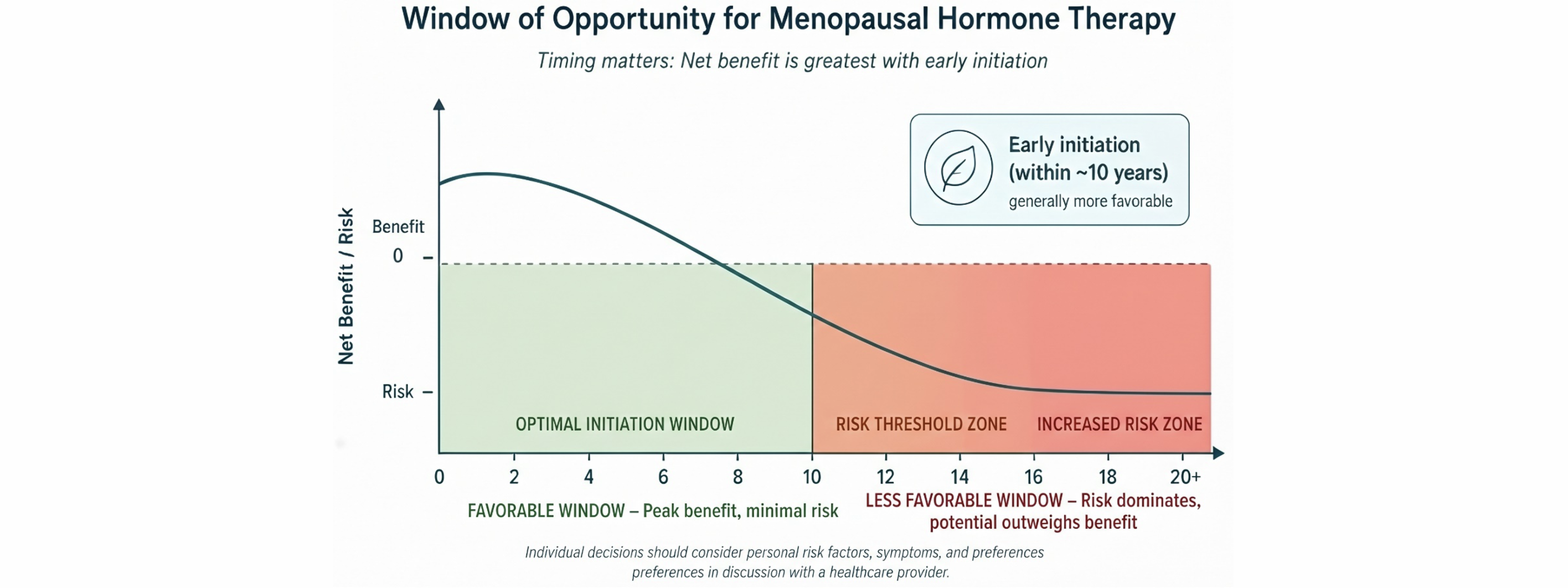
Today, MHT remains the most effective pharmacologic treatment for bothersome vasomotor symptoms in appropriate candidates. Treatment duration is guided by periodic individualized assessment rather than an arbitrary universal stopping age. Systemic MHT is not recommended solely to prevent cardiovascular disease or dementia.
Emerging Population-Scale Evidence on Systemic Effects
A 2026 Nature Medicine analysis examining more than 300 million laboratory tests from over one million women in the United States and Israel offers a complementary view of MHT’s broader physiological impact. Using a computational approach that reconstructs trajectories anchored to the final menstrual period, researchers identified abrupt, step-like physiological shifts—termed “physiological cliffs”—across numerous systems (endocrine, skeletal, hepatic, renal, lipid, and others) precisely at menopause. These “cliffs” were absent in men examined using the same methodology.
Current MHT use was associated with attenuation of several biomarker changes, particularly in bone-related, liver, and renal/osmolality markers. This large observational analysis provides insight into physiological associations around menopause but cannot establish that MHT prevents clinical organ disease or improves long-term survival. Potential healthy-user effects and other confounding must be considered.
Dissecting the Risks for MHT: Breast Cancer, Cardiovascular Health and Brain Health
1. Breast Cancer
While the original WHI trial reported an increased incidence of breast cancer associated with combined conjugated equine estrogens plus medroxyprogesterone acetate in an older cohort, subsequent granular analyses reveal a more nuanced picture:
- Absolute risks remain modest for most women who start therapy near the time of menopause.
- In the WHI randomized trial of women with prior hysterectomy, CEE alone was associated with lower breast cancer incidence and mortality during long-term follow-up. These findings should not automatically be extrapolated to all estrogen formulations or clinical populations.
- Breast cancer risk differs by hormone regimen, duration, and individual risk profile. Combined CEE plus MPA increased breast cancer incidence in the WHI trial; the persistence of risk after stopping treatment varies and should not be described as uniformly disappearing rapidly.
2. Cardiovascular Health
Cardiovascular outcomes vary with age at initiation, baseline health, dose, and route. In appropriate younger symptomatic patients, the absolute risk of adverse events is often low, but MHT should not be prescribed to prevent cardiovascular events or extend life. Observational data suggest transdermal estradiol may carry lower venous thromboembolism risk than oral estrogen, although randomized head-to-head clinical outcome evidence is limited. Some studies report differences across racial and ethnic groups, highlighting the need for more representative research.
3. Brain Health and Cognition
Cognitive outcomes remain an active and nuanced area of research. Initiating systemic MHT after age 65 has been associated in some randomized trials with higher risk of dementia, whereas initiation within the window of opportunity (before age 60 or within roughly 10 years of menopause) has generally shown neutral effects and, in selected observational, neuroimaging, and biomarker studies, potentially favorable associations with Alzheimer-related pathology and certain memory domains.

A 2024 systematic review and meta-analysis of 34 randomized trials found formulation- and timing-dependent effects, with estrogen-only therapy started near menopause linked to improvements in verbal memory and global cognition in some analyses. A 2025 Neurology analysis from the Canadian Longitudinal Study on Aging (Galea and colleagues) further showed that earlier age at menopause was associated with lower cognitive scores, while transdermal estradiol was linked to better episodic memory and oral estradiol to better prospective memory compared with never-use. More recent work, including a 2026 Neurology study, has reported lower odds of Alzheimer neuropathology and clinical dementia diagnoses among estrogen-only MHT users. Evidence from randomized cognitive trials, observational studies of dementia diagnoses, and imaging or neuropathology research addresses different endpoints and should not be interpreted interchangeably. MHT is not indicated for the primary prevention of dementia or cognitive decline. Other residual risks that clinicians evaluate include gallbladder health and the critical need to add a progestogen for women with a uterus to protect the endometrium.
Although neuroimaging and observational work raises intriguing questions about possible neuroprotective associations, randomized clinical trial evidence has not established that starting MHT around menopause prevents dementia. Current clinical recommendations focus on treatment of established menopausal indications rather than cognitive protection.
Expanding Access: Supply Chains, Insurance Coverage, and Health Equity
Despite monumental scientific and regulatory progress, practical barriers to care persist:
- Supply Chain Strains: Demand for MHT—particularly transdermal estradiol patches—surged following the 2025 regulatory updates, causing intermittent supply shortages. Many patients have had to navigate product switches or temporary interruptions while manufacturers ramp up production capacity.
- Disparities in Care: Insurance coverage, medication affordability, access to menopause-trained clinicians, and prescribing patterns vary across communities. Generic formulations and telehealth may improve access for some women, but financial and structural barriers persist, particularly in underserved populations. Closing these gaps is an important public health priority.
Nonhormonal Alternatives
For women who have medical contraindications to hormone therapy or simply prefer nonhormonal approaches, a robust suite of targeted alternatives has emerged:
- Neurokinin NK3-Receptor Antagonists: Fezolinetant (Veozah, approved in 2023) and elinzanetant (Lynkuet, approved in 2025) target hypothalamic pathways involved in vasomotor symptoms. Clinical trials demonstrate clinically meaningful reductions in hot-flash frequency and severity; elinzanetant has also shown sleep-related benefits in some trials. Fezolinetant carries an FDA boxed warning for rare but serious liver injury: liver testing is required before initiation, monthly for the first three months, and at months six and nine. Clinicians should review the current prescribing information and product-specific contraindications before treatment.
- SSRI and SNRI Medications: Specific selective serotonin reuptake inhibitors (SSRIs) and serotonin-norepinephrine reuptake inhibitors (SNRIs)—such as low-dose paroxetine—alongside gabapentin, offer proven relief.
Behavioral and Lifestyle Interventions
Evidence-based techniques such as cognitive behavioral therapy (CBT) and clinical hypnosis (supported by randomized trials and recommended by The Menopause Society) provide meaningful, nonpharmacological symptom management. Lifestyle measures —including regular physical activity, plant-forward or Mediterranean-style dietary patterns, weight management, and stress reduction—support overall midlife health and may modestly improve symptom burden or quality of life for some women, although their direct effect on hot-flash frequency is more modest than pharmacologic options.

Who May Not Be a Candidate for Systemic Hormone Therapy?
Systemic MHT may be inappropriate for women with unexplained vaginal bleeding, known or suspected estrogen-sensitive malignancy, prior venous thromboembolism, stroke, myocardial infarction, active or significant liver disease, or other important contraindications. The specific formulation and patient history matter, and management requires individualized evaluation. These systemic-therapy considerations should not be automatically applied to low-dose vaginal estrogen, which has a different systemic exposure and risk profile.
A Practical Clinical Pathway
Determining the appropriate individualized path involves a collaborative, shared decision-making framework between patient and clinician:
- Assess individual symptom burden and quality-of-life impact.
- Confirm timing relative to age and the menopausal transition (“window of opportunity”).
- Screen thoroughly for medical contraindications.
- Select the appropriate modality: systemic MHT (prioritizing transdermal routes when thrombotic risks are a concern and adding a progestogen if the uterus is intact), local vaginal estrogen strictly for genitourinary symptoms, or targeted nonhormonal therapies.
Closing the Public Education Gap
Despite widespread media coverage, survey data indicates that large majorities of women feel inadequately informed about menopause before symptoms strike. Many only discover treatment options after experiencing major disruptions to their sleep, mental well-being, and careers. Furthermore, clinician training remains uneven; many medical residency programs still offer limited formal education on menopause management, leaving residual fear rooted in outdated interpretations of legacy data.
Where to Find Trusted Guidance:
Organizations such as The Menopause Society provide exceptional patient-education tools, a searchable directory of Certified Menopause Practitioners, and multimedia resources like their consumer video and podcast series featuring expert interviews on hormone therapy and symptom management. Experts recommend initiating proactive conversations with healthcare providers during annual wellness visits in your early 40s.
Looking Ahead
The 2025–2026 labeling changes represent a substantial shift in how regulators communicate MHT risks and benefits. The goal is to support informed access for appropriate candidates while preserving careful assessment of contraindications and residual risks. Going forward, public health priorities include equitable care, reliable supply, clinician education, and more rigorous research into long-term outcomes.
Ultimately, clearer labeling, expanded nonhormonal choices, and a precise appreciation of the “window of opportunity” empower women and clinicians to craft personalized, evidence-based care plans. As part of the ongoing Rutgers Women’s Brain Health Initiative series, this two-part article highlights our continued commitment to delivering clear, research-informed guidance—ensuring that midlife is viewed not simply as a hurdle to navigate, but as a critical checkpoint to safeguard lifelong brain health, vitality, and well-being.
Note: This article is published for educational and informational purposes by the Rutgers Women’s Brain Health Initiative and does not constitute medical advice. Individual health decisions should always be made in consultation with a qualified clinician.
Related Resources


References
- U.S. Food and Drug Administration. FDA Approves Labeling Changes to Menopausal Hormone Therapy Products. February 12, 2026. FDA Approves Labeling Changes to Menopausal Hormone Therapy Products | FDA
- U.S. Department of Health and Human Services / FDA. HHS Advances Women’s Health, Removes Misleading FDA Warnings on Hormone Replacement Therapy. November 10, 2025 HHS Advances Women’s Health, Removes Misleading FDA Warnings on Hormone Replacement Therapy | HHS.gov
- The 2022 hormone therapy position statement of The North American Menopause Society. Menopause. 2022;29:767-794 The 2022 hormone therapy position statement of The North American Menopause Society – PubMed (and subsequent updates).
- Pinkerton JV, Simon JA, Hodis HN, et al. Report of the FDA’s expert panel on hormone therapy. Menopause. 2026;33:1118-1126. Report of the FDA’s expert panel on hormone therapy – PMC
- Wang Z, et al. Menopausal Hormone Therapy and Cardiovascular Risk in Midlife Women With Vasomotor Symptoms. JAMA Intern Med. 2026. https://jamanetwork.com/journals/jamainternalmedicine/fullarticle/2853611
- Makary MA, et al. Updated Labeling for Menopausal Hormone Therapy. JAMA. 2026;335(2):117-118. Updated Labeling for Menopausal Hormone Therapy | Women’s Health | JAMA | JAMA Network
- Pridham G, et al. Population-scale reconstruction of menopause dynamics reveals a physiological cliff at the final menstrual period. Nature Medicine. 2026. https://doi.org/10.1038/s41591-026-04614-0
- Manson JE, et al. Menopausal hormone therapy and long-term all-cause and cause-specific mortality. JAMA. 2017;318:927-938; and related WHI breast-cancer follow-up analyses. Menopausal Hormone Therapy and Long-term All-Cause and Cause-Specific Mortality: The Women’s Health Initiative Randomized Trials – PubMed
- Rossouw JE, et al. Menopausal Hormone Therapy and Cardiovascular Diseases in Women With Vasomotor Symptoms (WHI secondary analysis). JAMA Intern Med. 2025. Menopausal Hormone Therapy and Cardiovascular Diseases in Women With Vasomotor Symptoms: A Secondary Analysis of the Women’s Health Initiative Randomized Clinical Trials | Trials | JAMA Internal Medicine | JAMA Network
- U.S. Food and Drug Administration. FDA Drug Shortages Database (check current product-specific entries). https://www.accessdata.fda.gov/scripts/drugshortages/default.cfm
- U.S. Food and Drug Administration. Veozah (fezolinetant) safety communication: rare but serious liver injury and monitoring requirements. https://www.fda.gov/drugs/drug-safety-communications/fda-adds-warning-about-rare-occurrence-serious-liver-injury-use-veozah-fezolinetant-hot-flashes-due
- The Menopause Society. Patient education resources and practitioner finder. https://menopause.org/; and surveys on menopause knowledge gaps (including UCL-led and related 2025 research).
- American Academy of Neurology. Hormone therapy type matters for memory performance after menopause. Press release. August 27, 2025. https://www.aan.com/PressRoom/Home/PressRelease/5280
- Bruno J, Shaw JS and Hosseini Hadi SM. Association Between Menopausal Hormone Therapy and Alzheimer Disease Neuropathology. Neurology. 2026;107(5):e218413. doi:10.1212/WNL.0000000000218413. https://www.neurology.org/doi/10.1212/WNL.0000000000218413
- Barth C, Galea LAM, Jacobs EG, Lee BH, Westlye LT, de Lange AMG. Menopausal hormone therapy and the female brain: leveraging neuroimaging and prescription registry data from the UK Biobank cohort. eLife. 2025 (reviewed preprint). doi:10.7554/eLife.99538. https://elifesciences.org/reviewed-preprints/99538
- Andy C, Nerattini M, Jett S, et al. Systematic review and meta-analysis of the effects of menopause hormone therapy on cognition. Front Endocrinol (Lausanne). 2024;15:1350318. doi:10.3389/fendo.2024.1350318. https://pmc.ncbi.nlm.nih.gov/articles/PMC10944893/
- Puri TA, Gravelsins LL, Wood Alexander M, McGovern AJ, Duarte-Guterman P, Rabin JS, Murphy KJ, Galea LAM. Association Between Menopause Age and Estradiol-Based Hormone Therapy With Cognitive Performance in Cognitively Normal Women in the CLSA. Neurology. 2025;105:e213995. doi:10.1212/WNL.000000000021399
- U.S. Food and Drug Administration. Veozah prescribing information and boxed warning on hepatotoxicity. https://dailymed.nlm.nih.gov/dailymed/drugInfo.cfm?setid=cae9f798-24f9-4580-a4fc-e6c710cbda3c
