

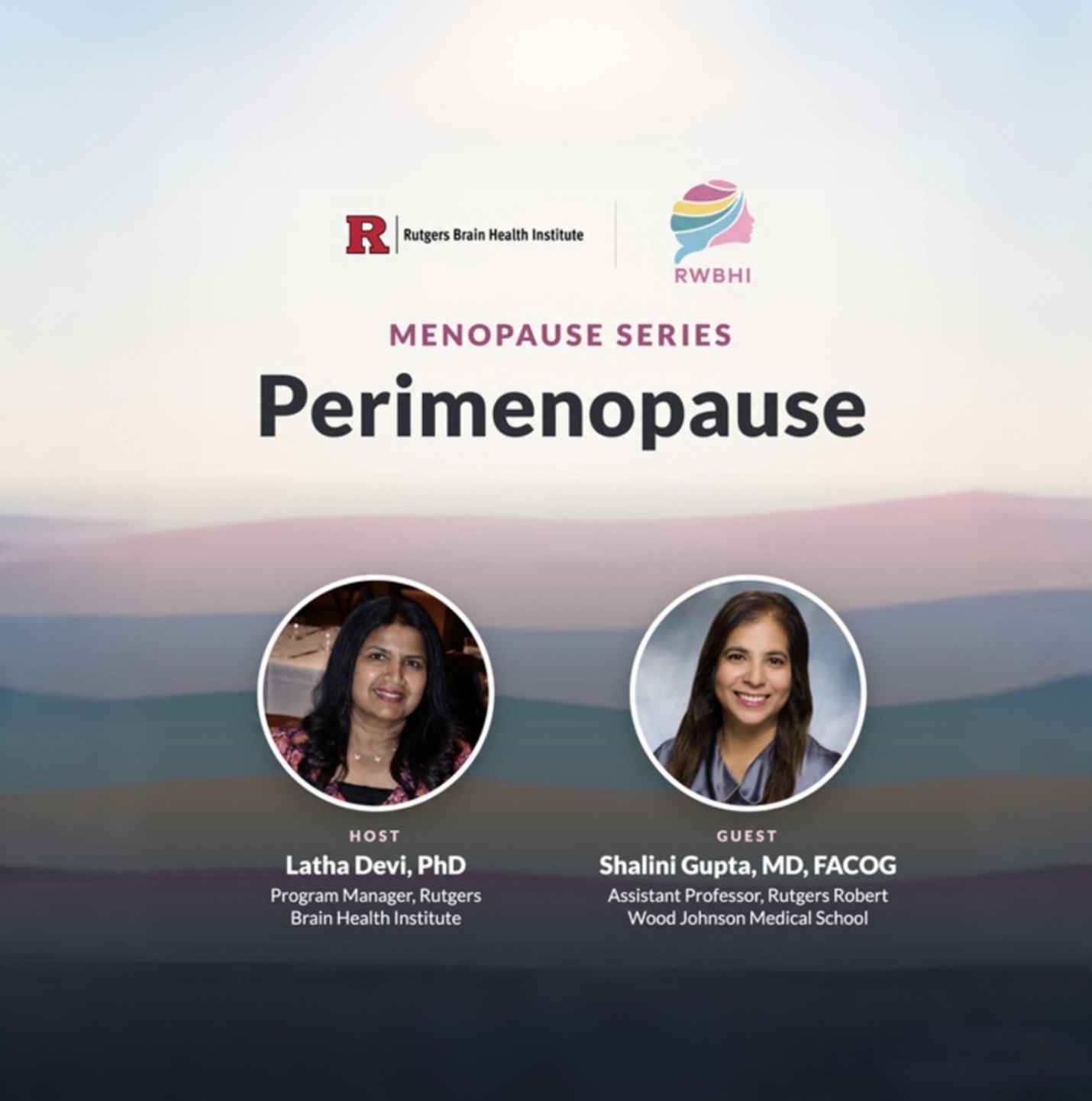
Rutgers Women’s Brain Health Initiative – Menopause Series | Perimenopause: Recognition, Treatment, and Maintaining Health

A Q&A with Shalini Gupta, MD, FACOG
This article is the first in our new series from the Rutgers Women’s Brain Health Initiative (RWBHI) exploring the key topics in menopause and women’s health in midlife. Following our introductory overview, “Menopause: A Key Transition in Women’s Brain Health,” we turn to the practical questions many women and clinicians face during the menopausal transition-starting with recognition, diagnosis, and evidence -based management of common symptoms.
Dr. Shalini Gupta is a board-certified obstetrician-gynecologist and a credentialed menopause expert. In addition to being a Fellow of the American College of Obstetricians and Gynecologists (FACOG), she holds the Menopause Society Certified Practitioner (MSCP) credential, issued by The Menopause Society (formerly known as NAMS). She serves as an Assistant Professor in the Department of Obstetrics, Gynecology and Reproductive Sciences at Rutgers Robert Wood Johnson Medical School and is affiliated with Robert Wood Johnson University Hospital in New Brunswick and Somerset, New Jersey.

A skilled minimally invasive gynecologic surgeon with more than 14 years of clinical experience, Dr. Gupta is passionate about helping women navigate the menopausal transition with confidence and compassion. She emphasizes shared decision-making, individualized care, and patient empowerment at every stage of life. In this conversation, Dr. Gupta addresses common questions about recognizing perimenopause, managing symptoms, the role of hormone therapy, long-term health considerations, and practical advice for women and clinicians.
“Perimenopause is not a single symptom or a single moment—it is a transition, and it can look very different from one woman to another.”
Podcast Episode – Perimenopause: Symptoms, Brain Fog, and Treatment with Dr. Shalini Gupta
Through conversations with clinicians and researchers, this series examines symptoms, treatment options, and changes in sleep, mood, and cognition. We connect clinical experience with emerging research, offering clear explanations and practical perspectives for women and the people who support them through midlife and beyond.
Accordion Content
“Women should not have to wait until their symptoms become unbearable before asking for help. If something is affecting your quality of life, it deserves a conversation.”
-
One of the earliest and most common signs is a change in the menstrual cycle. Periods may become shorter or longer, closer together or farther apart, heavier or lighter. But many women experience symptoms even before their periods become obviously irregular.
Symptoms that are often overlooked include sleep disruption, new or worsening anxiety, mood changes, difficulty concentrating or “brain fog,” fatigue, headaches, breast tenderness, joint aches, and changes in sexual desire. Women may not immediately connect these symptoms with hormonal changes, particularly when they are still menstruating regularly.
Hot flashes and night sweats are perhaps the best-known symptoms, but they are certainly not the only presentation. Perimenopause is a transition characterized by significant hormonal fluctuations, so symptoms can vary substantially from one woman to another.
A key message is that you do not have to wait until your periods stop to be experiencing symptoms related to the menopausal transition. American College of Obstetricians and Gynecologists (ACOG) notes that changes in menstrual patterns, hot flashes, sleep problems, vaginal dryness and painful intercourse can all occur during perimenopause.
-
Women should seek evaluation whenever symptoms are interfering with their sleep, work, relationships, sexual health, emotional well-being, or overall quality of life. There is no reason to wait until symptoms become severe.
Changes in bleeding are common during perimenopause, but abnormal bleeding should not automatically be attributed to hormones. Women should speak with their clinician about very heavy bleeding, bleeding lasting significantly longer than usual, frequent bleeding between periods, or bleeding after intercourse. Depending on age and risk factors, additional evaluation may be appropriate.
More urgent evaluation is warranted for symptoms such as very heavy bleeding associated with dizziness or weakness, chest pain, shortness of breath, new neurologic symptoms, or severe sudden-onset symptoms.
And importantly, once a woman has reached menopause—defined as 12 months without a menstrual period—any vaginal bleeding should be evaluated.
-
For most women over approximately age 45, perimenopause is primarily a clinical diagnosis based on age, symptoms and changes in menstrual patterns.
Routine hormone testing is generally not very helpful because estrogen and FSH levels can fluctuate significantly from day to day during perimenopause. A single “normal” hormone level therefore does not rule it out, and an abnormal value does not necessarily establish the diagnosis.
ACOG similarly advises that most women do not need hormone testing to diagnose perimenopause. Testing may be appropriate in certain situations, particularly when symptoms or menstrual changes occur before age 45 and especially before age 40, when premature or early menopause needs to be considered.
Testing can also be useful when we are evaluating other possible causes of symptoms, such as thyroid disorders, anemia, pregnancy, or other medical conditions.
Accordion Content
“One of the most important shifts in menopause care is moving away from a one-size-fits-all approach. The right treatment depends on the woman in front of us—her symptoms, her health history, her risks and her priorities.”
-
Treatment should be individualized because women experience very different combinations of symptoms.
For hot flashes and night sweats, menopausal hormone therapy remains the most effective treatment for appropriate candidates. There are also effective nonhormonal prescription options, including certain SSRIs and SNRIs, gabapentin and other FDA-approved therapies. The Menopause Society has specifically published evidence-based recommendations regarding nonhormonal treatment of vasomotor symptoms.
Lifestyle measures—including maintaining a healthy weight, regular physical activity, limiting alcohol, identifying personal triggers and using cooling strategies—may help some women, although lifestyle changes alone may not adequately control moderate-to-severe symptoms.
For sleep problems, it is important to determine what is actually disrupting sleep. If night sweats are waking a woman repeatedly, treating the vasomotor symptoms can dramatically improve sleep. We also consider insomnia, anxiety, restless legs, sleep apnea and other conditions that become more prevalent in midlife.
For mood symptoms, exercise, good sleep, psychotherapy when appropriate, and treatment of underlying anxiety or depression can all be helpful. Hormonal fluctuations can exacerbate mood symptoms in susceptible women, but significant depression or anxiety should never simply be dismissed as “just hormones.”
And with brain fog, women frequently describe word-finding difficulty, forgetfulness or problems multitasking. Sleep disruption, stress and mood symptoms often contribute significantly. Reassurance is important: these symptoms do not automatically indicate dementia. Optimizing sleep, physical activity, cardiovascular health and mental health is an important part of treatment.
-
Hormone therapy has undergone an important reassessment over the past two decades. We now understand that the risks and benefits depend significantly on a woman’s age, the timing of treatment, her medical history, the formulation used and the route of administration.
For healthy, appropriately selected women with bothersome symptoms—particularly those younger than 60 or within approximately 10 years of menopause—the benefit-risk profile is generally favorable.
Hormone therapy is the most effective treatment for hot flashes and night sweats, helps with vaginal symptoms, and prevents the accelerated bone loss associated with menopause.
If a woman has a uterus, systemic estrogen generally needs to be combined with adequate progesterone or another progestogen to protect the endometrium.
Risk assessment is individualized. Systemic hormone therapy is generally not recommended for women with certain histories, including some hormone-sensitive cancers, previous blood clots, stroke, heart attack or significant liver disease. Oral estrogen carries a small increased risk of venous thromboembolism, while transdermal preparations may have a more favorable clotting-risk profile in appropriate patients.
Another misconception is that hormone therapy should be prescribed primarily to prevent cardiovascular disease. It should not be started solely for that purpose. Rather, we prescribe it primarily for symptom treatment and, in selected circumstances, bone protection.
The decision should ultimately be based on shared decision-making rather than a one-size-fits-all rule.
Accordion Content
Accordion Content
“I tell patients to think of midlife as a health checkpoint. Treat the symptoms that are bothering you, but also use this opportunity to protect your bones, heart, muscle and brain for the decades ahead.”
-
These symptoms are extremely common and unfortunately remain underreported because many women assume they are simply something they have to live with.
Declining estrogen can affect the vagina, vulva, bladder and urethra. Women may experience vaginal dryness, burning, irritation, decreased lubrication, painful intercourse, urinary frequency or urgency, and recurrent urinary tract infections. Collectively, we refer to this as genitourinary syndrome of menopause, or GSM.
Unlike hot flashes, which often improve eventually, genitourinary symptoms frequently persist or worsen without treatment.
Initial options may include vaginal moisturizers used regularly and lubricants during intercourse. For women with persistent symptoms, low-dose vaginal estrogen is highly effective and delivers very small amounts of estrogen directly to affected tissues. Other prescription therapies are also available, including vaginal DHEA and certain selective estrogen receptor modulators.
Sexual discomfort deserves specific attention as well. Pain with intercourse may involve not only hormonal changes but also pelvic-floor dysfunction, vulvar conditions, infection or other causes, so persistent symptoms should be evaluated rather than simply tolerated.
-
Menopause should be viewed not only as a reproductive transition but also as an important opportunity to reassess a woman’s long-term health trajectory.
Bone: Estrogen plays an important role in preserving bone. Bone loss accelerates around the final menstrual period; ACOG notes that the period of rapid bone loss begins roughly one year before the final menstrual period and continues for several years afterward. Weight-bearing and resistance exercise, adequate calcium and vitamin D intake, avoiding tobacco and excessive alcohol, and appropriate osteoporosis screening are important.
Cardiovascular health: Cardiovascular disease remains the leading cause of death among women. Midlife is an important time to assess blood pressure, cholesterol, diabetes risk, smoking status, weight, physical activity and family history.
Metabolism: Aging and hormonal changes are associated with changes in body composition, including loss of lean muscle and redistribution of fat toward the abdomen. Resistance training and sufficient protein intake become particularly important in preserving muscle and metabolic health.
Brain health: Many women report cognitive changes during the menopausal transition, but there is no evidence that normal perimenopausal “brain fog” means that dementia is developing. The same measures that protect cardiovascular health—exercise, controlling hypertension and diabetes, avoiding smoking, maintaining social engagement and prioritizing sleep—also support long-term brain health.
I often tell patients that midlife is a health checkpoint. It is an excellent time to look beyond symptom treatment and focus on the next several decades of bone, cardiovascular, metabolic and cognitive health.
Accordion Content
“The goal of menopause care isn’t simply to manage hot flashes. It is to help women remain healthy, confident and functioning at their best during what can be several decades of life after menopause.”
-
There are several persistent myths.
One is that perimenopause begins only when periods stop. In reality, symptoms often begin years before menopause.
Another is that every woman experiences severe hot flashes. Some women never do and instead present with sleep disturbance, mood changes, menstrual changes or genitourinary symptoms.
A third is that hormone therapy is universally dangerous. We now recognize that its risks are much more nuanced and depend on age, timing, medical history, dose, formulation and route of administration.
The opposite misconception is also increasingly common—that hormone therapy is appropriate or necessary for every woman. It is not. Treatment should always be individualized.
Another myth is that compounded “bioidentical” hormone preparations are inherently safer or more natural than FDA-approved therapy. ACOG recommends FDA-approved formulations over compounded hormone therapy when approved options are available.
Providers can improve recognition simply by asking targeted questions during routine visits: Have your periods changed? How are you sleeping? Are you having hot flashes or night sweats? Has your mood changed? Are you experiencing vaginal dryness, sexual discomfort or urinary symptoms?
These questions normalize the conversation and often uncover symptoms patients did not realize were related.
-
First, learn what perimenopause can look like before you reach it. Women are much better equipped to recognize changes when they know that the transition involves far more than hot flashes.
Second, track your symptoms and menstrual patterns. Bringing a simple record to an appointment can be extremely helpful.
Third, do not minimize your symptoms. If sleep deprivation, painful intercourse, mood symptoms or hot flashes are interfering with your quality of life, tell your clinician specifically how they are affecting you.
Fourth, ask about the full range of treatment options. Women should understand both hormonal and nonhormonal approaches and participate in deciding what fits their priorities and medical history.
Finally, invest in the fundamentals of healthy aging: strength training, aerobic exercise, adequate protein and nutrition, sleep, cardiovascular risk assessment, bone health, mental health and meaningful social connection.
Perimenopause is not simply something women need to “get through.” With appropriate education, preventive care and individualized treatment, women can remain healthy, active and productive throughout this transition.
Estrogen Across A Woman’s Life
Estrogen is one of the main hormones shaping a woman’s health, and its level rises and falls in distinct patterns across life. Click a label to see the dramatic shorter-term changes up close.
Menstrual cycle: a monthly cycle through the reproductive years.
Pregnancy: a hundredfold rise during pregnancy.
Estrogen shapes mood, bone strength, and heart health. The scale and complexity of these swings are part of why they were long overlooked in research.
Expand your understanding of estrogen’s changing levels across female life stages and its links to health conditions with our illustrated factsheet.
Download FactsheetOne Menstrual Cycle
A menstrual cycle lasts about 28 days. Estrogen rises to a peak that triggers ovulation and the release of an egg. If pregnancy does not occur, the level falls and a period begins. This pattern repeats about once a month.
During Pregnancy
When pregnancy begins, the monthly cycle pauses and estrogen rises to roughly 100 times its usual level, reaching a maximum near birth. Afterward it drops sharply and the monthly cycle resumes. These are among the largest hormone changes the human body undergoes.
Rutgers Women’s Brain Health Initiative: Menopause Series


Support the Rutgers Women’s Brain Health Initiative
The Rutgers Women’s Brain Health Initiative (RWBHI) is dedicated to addressing the knowledge gap in women’s brain health by showcasing research on brain health problems that prominently affect women. We aim to deliver clear, trustworthy, and research-vetted actionable information that will directly benefit women and their families.
